Does General Aircon Servicing Really Treat the Cooling Coil?
Your air conditioner is serviced. But is the cooling coil actually hygienically treated?
For many homes and workplaces, regular aircon servicing is part of routine maintenance. Filters are removed and washed. Dust is removed. The unit is checked and basic functional care is performed.
But there is another question worth asking: What happens to the microscopic buildup that can remain on the cooling coil — the cold, damp surface where moisture and airborne contaminants come into contact?
This is the Hygiene Gap.
It does not mean that regular servicing is ineffective. It means that functional aircon maintenance and cooling-coil hygiene are not necessarily the same thing.
Cleanhale™ was developed around this distinction: a professional routine hygiene upgrade for the air conditioner, focused specifically on the cooling coil.
What Is the Cooling Coil?
The cooling coil, also called the evaporator coil, is one of the most important components inside a split air-conditioning system.
Warm indoor air passes across the cold coil surface. Heat is transferred away from the air, moisture condenses, and the cooled air is circulated back into the room.
This means the cooling coil sits directly in the airflow path. It is also a surface where moisture, dust and other airborne material can accumulate. Over time, this can create conditions in which microorganisms and organic residue remain attached to the coil surface.
Scientific studies have found bacteria and fungi associated with air-conditioning cooling coils, including evidence of microbial communities and biofilm formation on these surfaces.
So while the cooling coil is essential to cooling performance, it is also an important surface to consider when thinking about aircon hygiene.
The Hygiene Gap: Serviced Does Not Always Mean Hygienically Treated
The phrase "aircon servicing" can describe a range of different maintenance activities.
A routine General Service may include functional checks, filter washing, dust removal and basic care of accessible components.
That is important.
But the cooling coil may require a different treatment approach when the objective is specifically to address microbial buildup and residue.
This creates a simple distinction:
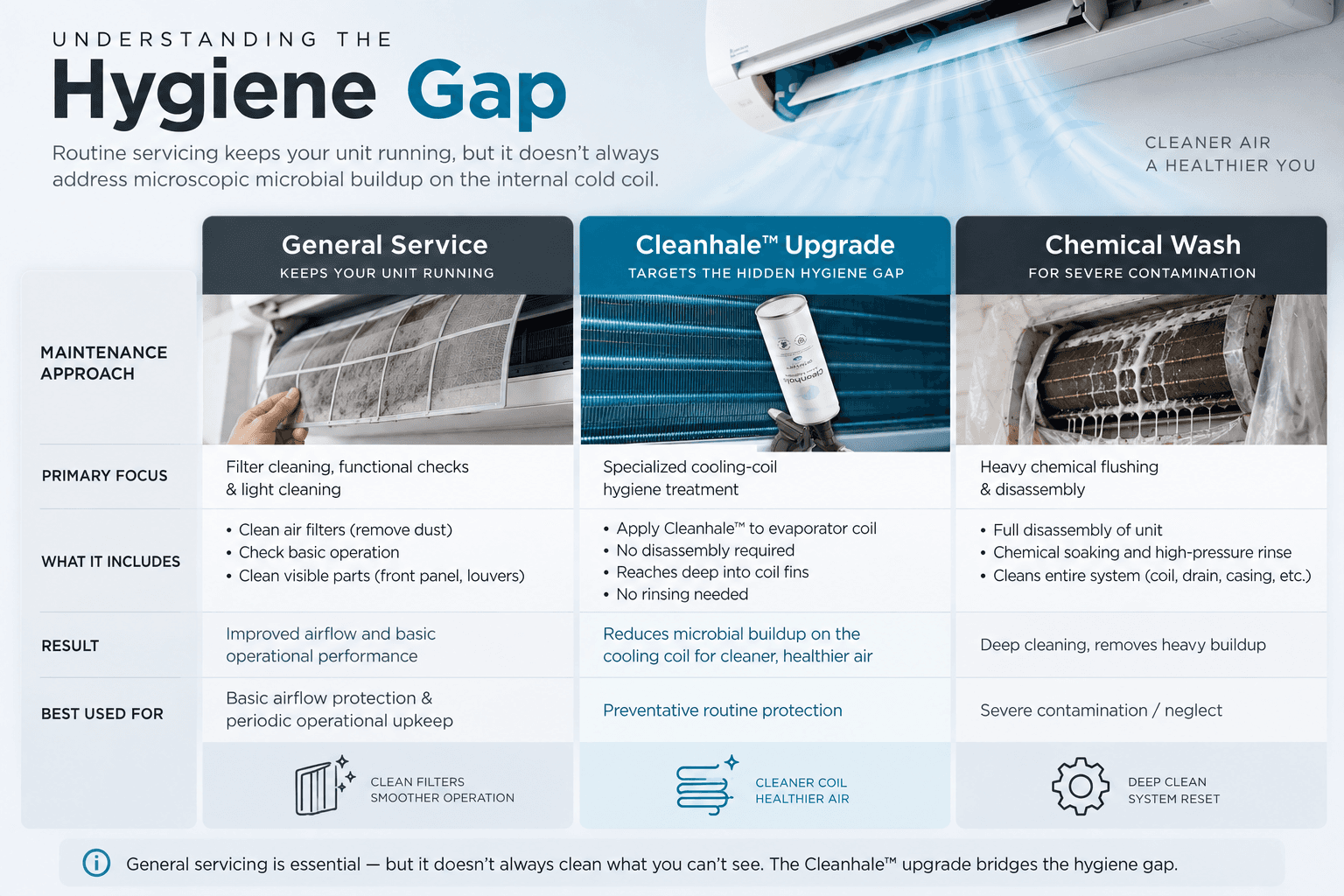
These approaches are not necessarily competing with one another.
They have different roles.
Cleanhale™ is designed to be added to General Service as a preventative routine hygiene upgrade for the cooling coil.
It is not a replacement for General Service.
It is also not intended to replace Chemical Wash when an air-conditioning system is severely contaminated.
Why Can Microbial Buildup Develop on an Aircon Coil?
The cooling coil operates in a very different environment from most surfaces inside a home.
During operation, the coil becomes cold. Moisture can condense on its surface. Air is continuously moving across it.
At the same time, airborne particles and organic material can come into contact with the coil.
This combination of moisture, temperature, airflow and deposited material creates an environment in which microorganisms can establish themselves on surfaces.
Research on commercial air-conditioning systems has found substantial bacterial and fungal loading on cooling coils.
One study of commercial air-conditioning cooling coils found approximately 12 million bacterial cells per square metre and approximately 760,000 fungal spore equivalents per square metre in the systems examined.
The exact amount of microbial material varies considerably depending on the building, system design, environment, filtration, moisture conditions and maintenance history.
The important point is not a single universal number. The important point is that cooling coils can support microbial buildup.
What Is a Biofilm?
One of the most important concepts in cooling coil hygiene is the biofilm.
A biofilm is a community of microorganisms attached to a surface and embedded within a matrix of substances produced by the microorganisms themselves.
In simple terms, microorganisms do not always exist as individual particles floating freely through the environment. They can attach to a surface and become part of a structured layer.
On an air-conditioning cooling coil, that layer can combine with other deposited material such as dust, organic residue and moisture. This can make the buildup more persistent than loose surface dust.
That is one reason why simply removing visible dust does not necessarily address every aspect of cooling coil hygiene.
Why Washing the Filter Is Not the Same as Treating the Coil
The cabin or dust filter has an important job. It helps capture airborne particles before they travel further into the air-conditioning system.
But the filter and cooling coil perform different functions.
The filter is designed to capture particles.
The cooling coil is where heat exchange takes place.
Air passes from the filter toward the cooling coil, meaning the coil remains an important downstream surface exposed to the air passing through the system.
Some material will inevitably deposit on surfaces inside an air-conditioning system.
This is why filter maintenance and cooling-coil hygiene should be viewed as complementary rather than interchangeable.
A clean filter does not automatically mean that the cooling coil has been hygienically treated.
That distinction is at the heart of the Hygiene Gap.
Why Moisture Matters
Moisture is a normal part of air-conditioning operation.
When warm, humid air passes across a cold cooling coil, water vapour can condense on the coil.
This condensation is necessary for dehumidification. But moisture also changes the conditions on the coil surface.
Research has identified moisture as one of the environmental factors associated with microbial loading on air-conditioning cooling coils.
In tropical environments, this becomes particularly relevant because air-conditioning systems operate under warm and humid outdoor conditions for much of the year.
The result is not that every cooling coil is automatically contaminated. Rather, the combination of moisture and deposited material means that cooling-coil hygiene deserves specific attention as part of an overall maintenance strategy.
Can Buildup Affect Airflow and Cooling Performance?
Potentially, yes.
The cooling coil is designed to transfer heat efficiently while allowing air to pass through its fin structure.
When biological material, dust and other deposits accumulate on the cooling coil, the surface condition and airflow path can change.
Research on biofouling of finned heat exchangers has demonstrated that buildup can reduce heat-transfer performance and increase airflow resistance under specific experimental conditions.
However, the effect is not a fixed percentage for every air conditioner.
The actual impact depends on the amount and type of buildup, coil design, airflow, operating conditions and other system factors.
That is why responsible aircon hygiene communication should avoid claiming that every contaminated coil automatically causes a particular energy loss.
The more useful principle is simple:
Keeping critical cooling surfaces in good condition supports the intended operation of the air-conditioning system.
Why Cleaning Once Does Not Necessarily Mean the Problem Is Gone Forever
Air-conditioning systems operate continuously.
Air keeps moving. Moisture continues to form. Dust and organic material continue to enter the system. Microorganisms are also continually present in the surrounding environment.
Research has observed changes and recolonisation in microbial communities on air-conditioning cooling coils over time.
This is why cooling-coil hygiene is better understood as part of a routine maintenance strategy rather than a one-time event.
The objective is not to promise a permanently sterile coil. The objective is to establish a practical routine for managing buildup before major corrective intervention becomes necessary.
That is the philosophy behind Cleanhale™.
Where Does Cleanhale™ Fit?
Cleanhale™ is a professional aircon cooling coil treatment designed as a routine hygiene upgrade.
It is added to General Service and focuses on the cooling coil.
The purpose is straightforward: Close the Hygiene Gap.
Instead of treating aircon hygiene as something that only needs attention once a system becomes heavily contaminated, Cleanhale™ introduces cooling-coil hygiene as a routine preventative step.
This makes it particularly suitable for professional service partners who want to add a hygiene upgrade to an existing General Service.
Cleanhale™ and General Service Have Different Roles
The easiest way to understand Cleanhale™ is not as a replacement for normal servicing, but as an additional layer.
General Service focuses on routine functional maintenance.
Cleanhale™ adds specific attention to cooling-coil hygiene.
A professional service can therefore follow a simple sequence:
Perform the normal General Service.
Inspect the condition of the air-conditioning system.
Identify whether routine cooling-coil hygiene is appropriate.
Offer Cleanhale™ as a hygiene upgrade.
Perform the professional treatment according to the approved application procedure.
This creates a more complete maintenance conversation with the customer.
The question is no longer only: "Has your aircon been serviced?"
It becomes: "Has the cooling coil also been hygienically treated?"
How Does Cleanhale™ Work?
Cleanhale™ uses a dual-action treatment approach combining its specialized chemical formulation with hydromechanical action.
The technical treatment concept is described through the OKTAFLEX Effect:
Penetrate
Prolong
Detach
Inhibit
Disconnect
Contain
Flush
Protect
These terms describe the technical treatment mechanism.
For customers, however, the explanation can remain much simpler:
Cleanhale™ is a professional routine hygiene treatment for the cooling coil, designed to address microbial buildup and residue that may accumulate on this critical surface.
The objective is not to make the customer understand every technical mechanism.
The objective is to make the Hygiene Gap understandable.
What Does the Testing Show?
Cleanhale™ has been tested by TÜV SÜD PSB Pte Ltd.
The approved Cleanhale™ efficacy claims are:
Eliminates up to 99.9994% of bacterial buildup and microbial residue.
Reduces yeast and mould count by up to 64.8%.
The bacterial reduction claim is based on laboratory surface testing against Pseudomonas aeruginosa. The yeast and mould reduction figure is based on snapshot sampling of air-conditioner cooling coils evaluated against SS 554 standards.
These results demonstrate performance under the specific test conditions and methods used.
They should not be interpreted as a guarantee of identical performance in every air-conditioning system or operating environment.
What Does "Up to 99.9994%" Actually Mean?
"Up to" matters.
A laboratory result is generated under defined conditions using a specific sample, test method, contact time and microorganism.
It does not mean that every air-conditioning coil in every building will experience exactly the same reduction.
The Cleanhale™ bacterial efficacy claim is based on laboratory surface testing against Pseudomonas aeruginosa.
This is why the responsible way to communicate the result is:
Eliminates up to 99.9994% of bacterial buildup and microbial residue, tested by TÜV SÜD PSB Pte Ltd.
It is not:
Eliminates all bacteria from every air conditioner.
Evidence becomes more credible when its boundaries are clearly explained.
What About Yeast and Mould?
Cleanhale™ has also been evaluated for yeast and mould reduction.
The approved claim is:
Reduces yeast and mould count by up to 64.8%, tested by TÜV SÜD PSB Pte Ltd.
This result comes from snapshot sampling of air-conditioner cooling coils evaluated against SS 554 standards. Again, the result relates to the specific samples, methods and conditions evaluated.
It should not be presented as a universal guarantee for every air-conditioning installation.
Is Cleanhale™ a Disinfectant or Biocide?
No.
Cleanhale™ is a specialized cooling-coil treatment designed to address buildup through its treatment and hydromechanical removal approach.
It is not positioned as a regulated chemical disinfectant or biocide.
This distinction is important.
Cleanhale™ is about routine cooling-coil hygiene — not creating a claim of permanent sterilisation or a permanently microorganism-free surface.
The goal is practical preventative hygiene as part of professional air-conditioning maintenance.
What About Allergy-Friendly Certification?
The originating product/formula, airco well®, carries an ECARF-related allergy-friendliness certification.
This should not automatically be presented as a certification of Cleanhale™ itself. The distinction matters because certification applies to the product or formula that was actually assessed.
Cleanhale™ Is Not for Every Situation
Routine hygiene treatment has a role. But not every air-conditioning system is in the same condition.
If a cooling coil is heavily contaminated, severely blocked or requires major corrective intervention, a chemical wash or other appropriate professional intervention may be necessary.
Cleanhale™ is not intended to replace that type of corrective work.
Instead:
Routine hygiene helps address the Hygiene Gap before major intervention becomes necessary.
This is similar to the difference between routine personal hygiene and a major corrective procedure.
The comparison is an analogy, not a medical claim.
How Often Should Cooling-Coil Hygiene Be Considered?
Cleanhale™ is positioned as a routine preventative hygiene upgrade that can be added approximately 1–2 times per year alongside General Service, depending on the system and service recommendation.
The appropriate frequency can vary according to factors such as:
Usage
Indoor environment
Occupancy
Dust levels
Humidity
Operating conditions
Maintenance history
Coil condition
The important principle is consistency.
Cooling-coil hygiene should be treated as part of an ongoing maintenance routine rather than something considered only after visible problems or smell appears.
The Simple Question Every Aircon Owner Can Ask
The next time someone tells you that your air conditioner has been serviced, ask one simple question:
"Was the cooling coil actually hygienically treated?"
It is a reasonable question because servicing and cooling-coil hygiene are related — but they are not necessarily identical.
You do not need to assume that your air conditioner is dirty. You do not need to assume that your technician has done something wrong.
You simply need to understand what was included in the service.
That is what closing the Hygiene Gap is about.
The Bigger Picture: Aircon Maintenance Has More Than One Layer
A well-maintained air-conditioning system is not simply about whether the unit turns on and produces cold air.
There are several layers of maintenance:
Function
Does the system operate correctly?
Physical condition
Are filters, fins, drainage and accessible components being maintained?
Cooling performance
Can the system transfer heat and move air as intended?
Hygiene
Has the cooling coil received appropriate attention to microbial buildup and residue?
Each layer has a role.
Cleanhale™ focuses specifically on the last one.
The Cleanhale™ Approach
Cleanhale™ takes a simple position:
Aircon hygiene should become a routine - not a reaction.
The cooling coil is an important part of the air-conditioning system. It is exposed to airflow. It becomes wet during normal operation. Microbial communities and organic deposits can develop on cooling-coil surfaces.
And routine functional servicing does not necessarily mean that the cooling coil has received a dedicated hygiene treatment.
That is the Hygiene Gap. Cleanhale™ is designed to close it.
Frequently Asked Questions
Does regular aircon servicing clean the cooling coil?
Normally not.
General Service typically addresses routine functional maintenance and basic care. Whether the cooling coil receives a dedicated hygiene treatment depends on what the service includes.
Cleanhale™ is designed specifically as a routine cooling coil hygiene upgrade added to General Service.
Is the cooling coil important for aircon hygiene?
Yes.
The cooling coil is directly involved in the air-cooling process and is exposed to the airflow passing through the system. Because moisture can condense on its surface, it can also provide conditions where microorganisms and organic residue may accumulate and grow.
What is the Hygiene Gap?
The Hygiene Gap is the difference between maintaining the functional condition of an air-conditioning system and specifically addressing hygiene on the cooling coil.
What is a biofilm?
A biofilm is a community of microorganisms attached to a surface and embedded within a matrix produced by the microorganisms.
On an air-conditioning cooling coil, microbial material can coexist with moisture, dust and organic residue.
Does a clean aircon filter mean the cooling coil is hygienically treated?
No.
The filter and cooling coil perform different functions. A well-maintained filter is important, but it does not automatically mean that the cooling coil has received a dedicated hygiene treatment.
Is Cleanhale™ a replacement for normal aircon servicing?
No.
Cleanhale™ is designed as an add-on hygiene upgrade to General Service for the cooling coil.
Is Cleanhale™ a replacement for chemical washing?
No.
If an air-conditioning system requires major corrective intervention because of severe contamination, an appropriate professional corrective procedure may still be required.
How often should Cleanhale™ be applied?
Cleanhale™ is positioned as a routine preventative hygiene upgrade that can be considered approximately 1–2 times per year alongside General Service, depending on the system and professional service recommendation.
Does Cleanhale™ eliminate all microorganisms?
No universal claim should be made.
Cleanhale™ has documented test results under specific laboratory conditions. The approved claim is that it eliminates up to 99.9994% of bacterial buildup and microbial residue under the relevant test conditions and reduces yeast and mould count by up to 64.8%.
Is Cleanhale™ a biocide?
No.
Cleanhale™ is positioned as a specialized cooling-coil treatment and is not a regulated chemical disinfectant or biocide.
Where is Cleanhale™ made?
Cleanhale™ is engineered and made in Germany.
A Better Aircon Maintenance Question
Most people ask:
"Has my aircon been serviced?"
A better question is: "Has my aircon been serviced — and has the cooling coil been hygienically treated?"
That small change in the question creates a much clearer understanding of aircon maintenance.
Because functional maintenance matters. And cooling-coil hygiene matters too.
They simply address different parts of the same system.
Cleanhale™
Clean Air. Healthy Living.
In-Text References & Scientific Links
[1] Microbial Ecology on HVAC Coils: Bacterial and fungal ecology on air conditioning cooling coils is influenced by climate and building factors. Building and Environment (DOI Link).
[2] Bioaerosol Generation from AC Systems: Fungal contamination and bioaerosol emission in residential HVAC systems. Indoor Air Journal (DOI Link).
[3] EPS Matrix Architecture: The biofilm matrix. Flemming, H. C., & Wingender, J., Nature Reviews Microbiology (DOI Link).
[4] Deep-Coil Rinsing Performance: Effects of biofouling and cleaning on air-side heat transfer and pressure drop for finned tube heat exchangers. ASHRAE / HVAC&R Research (DOI Link).
[5] Antimicrobial Resistance in Biofilms: Mechanisms of microbial resistance in biofilm communities. MDPI Microorganisms (DOI Link).
[6] VOC Emissions from Commercial Cleaners: Indoor air quality impacts of aerosolized surface disinfectants and chemical cleaning agents. Atmospheric Environment (DOI Link).
[7] Indoor Bioaerosols & Disease: Biofilm Formation and Microbial Contamination in HVAC Systems. Journal of Hospital Infection (DOI Link).
[8] Building-Related Symptoms & Coil Contamination: Effect of ultraviolet lamps in air conditioning systems on worker health and wellbeing. The Lancet (DOI Link).
[9] HVAC Biofouling & Thermal Degradation: An energy efficiency and cost analysis of utilizing coil biofilm removal techniques. Applied Thermal Engineering (DOI Link).
[10] Energy Penalty of Biofouled Coils: Impact of HVAC cooling coil fouling on whole-building energy consumption. Energy and Buildings (DOI Link).